Third-party risk
Structured supplier and processor oversight within one connected platform
Acompli maintains supplier, processor, system, and location records as part of a connected privacy workflow, with those entities available across assessments, risk, and RoPA. Due diligence activity, supporting records, and downstream outputs remain linked within the same platform.
One platform. One licence. Every module feeds the next.
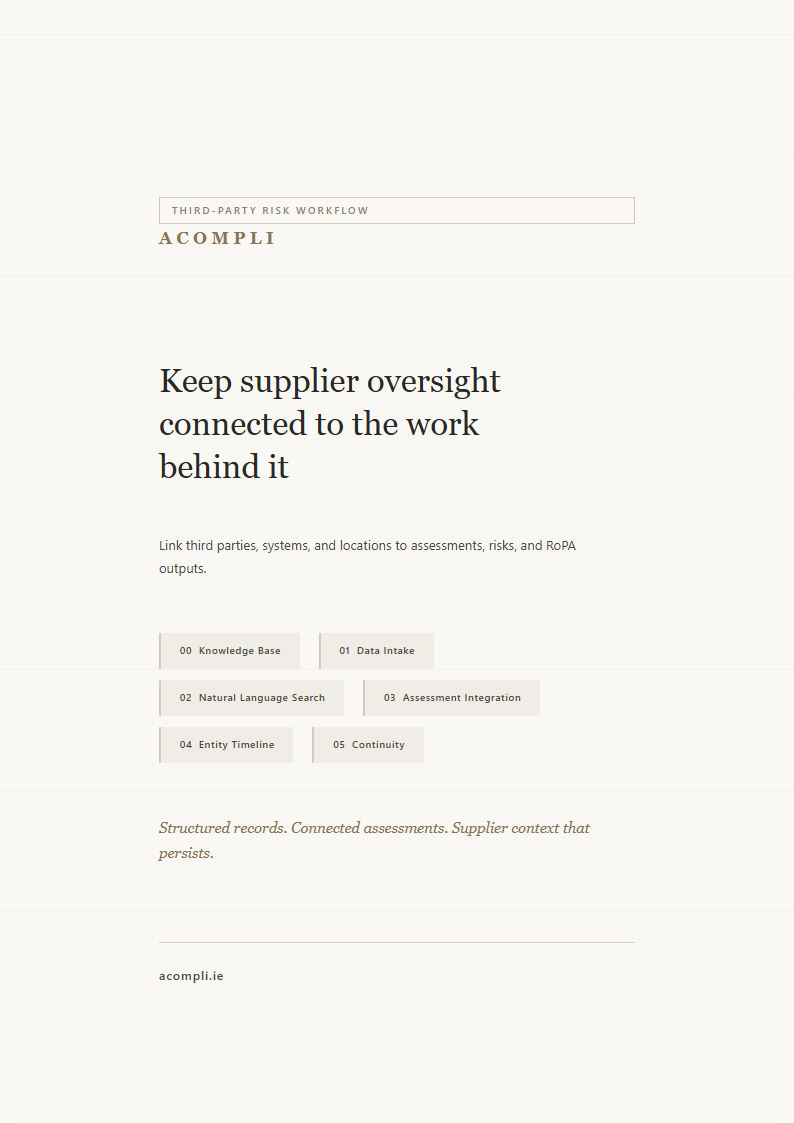
From entity record to connected compliance output
Five stages keep supplier and processor records linked to assessments, risk, and Article 30 outputs within one platform.
Systems, suppliers, and locations in one connected register
Maintain structured records for the organisational entities commonly referenced in privacy work. Those records are not kept in isolation — they can be reused across assessments, risk workflows, and Article 30 records.
The same entities can be referenced across assessment workflows and reused in downstream outputs, with links back to the underlying records and source context.
IT Systems
Structured records for systems involved in processing personal data, with operational and ownership context.
Third Parties
Processors and external parties recorded once, then referenced across due diligence, assessments, risk, and RoPA.
Locations
Geographic and operational context linked to supplier and system records within the same structure.
Third-party risk connected
Supplier and processor oversight as part of one connected privacy workflow. Knowledge Base records, assessments, risk, and RoPA outputs working together.
Frequently Asked Questions
A processor register is a maintained inventory of every third party that processes personal data on your behalf under a documented instruction (Article 28 GDPR). It records the processor's identity, processing scope, transfer arrangements, security measures, and contractual status. GDPR does not specify a format for the processor register, but Article 5(2) accountability requires that organisations demonstrate compliance on demand. In practice, a processor register that is current, complete, and evidenced by reviewed contracts and assessed relationships is one of the most frequently requested documents in regulatory investigations and supervisory audits.