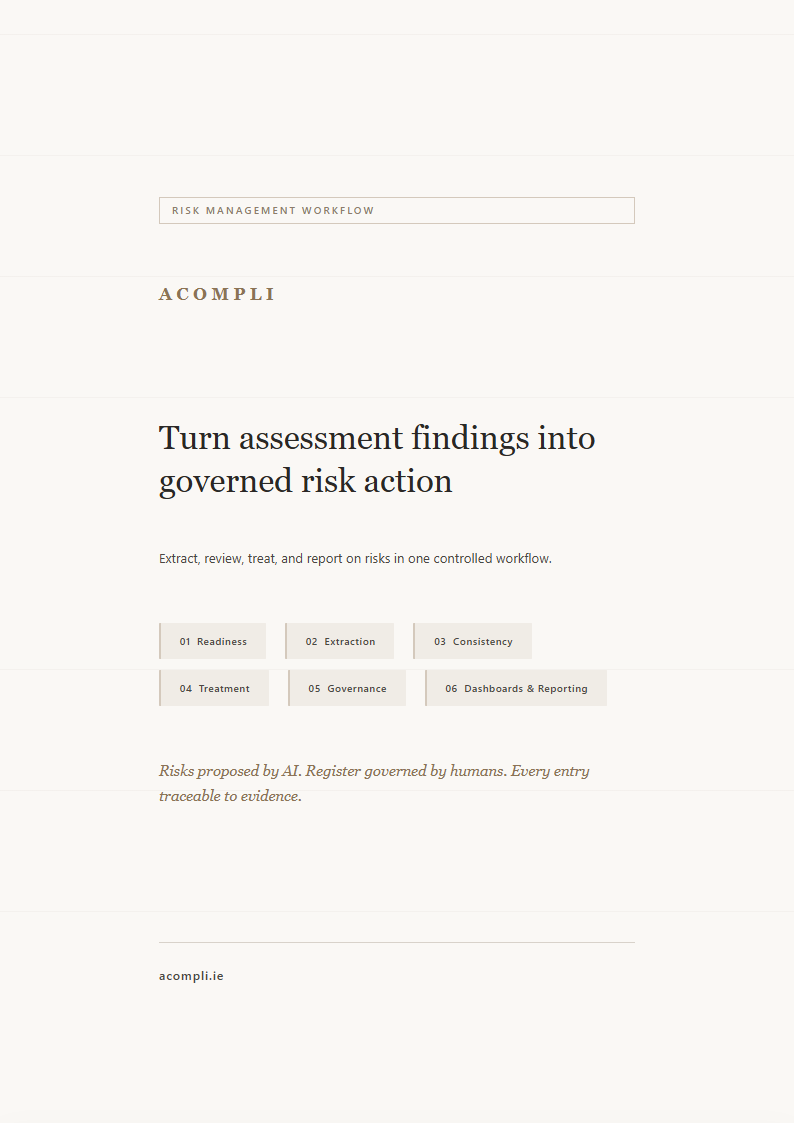
Risk management
Spreadsheet risk registers go stale the day they're created
When the board asks about your data protection risk posture, you're reconciling tabs — not presenting evidence. Entries are months old, disconnected from the DPIAs that identified them, and nobody remembers who owns what. Acompli analyses approved assessments to surface real risks, suggest mitigations and keep owners accountable — with readiness checks, structured extraction and consistency analysis that ties every entry back to source evidence.
Why teams trust Acompli with risk
Insights grounded in real work
No more spreadsheets or stale registers. Acompli ties risks back to evidence so you always know the why behind every entry.
1. Readiness check
Acompli validates coverage, flags quality signals and highlights missing inputs so your team can patch gaps while context is fresh.
Risk-heavy questions are flagged and queued for analysts before anything slips downstream.
2. Structured extraction
AI analyses every answered question and drafts structured risk entries for review – complete with titles, categories, inherent and residual scoring, existing controls and suggested mitigations for consideration – all with confidence badges and links back to the source questions and answers.
Ownership, review cadence and evidence are captured automatically so follow-up is immediate.
3. Consistency analysis
Duplicate detection, severity validation and correlation checks keep the register coherent. Acompli flags where mitigation plans collide or where similar risks appear across programmes.
Dashboards update in real time so trends and hotspots are obvious – and export-ready for board packs.
How risk stays alive in Acompli
Draft risk entries are generated as assessments close, so teams can spend time on mitigation instead of reconciliation.
- Flag automatically – approved DPIAs trigger readiness checks that confirm the context is ready.
- Extract deliberately – structured proposals arrive with confidence scores, evidence links and suggested mitigation steps.
- Assign ownership – reviewers accept, tweak or merge risks while SLAs and review cadences are captured in-line.
- Track progress – comments, decisions and attachments stay attached to the risk as it moves through treatment.
- Report instantly – dashboards and exports reflect the latest status, severity and residual risk without extra reconciliation.
What customers see
- Fewer surprises – emerging issues surface early.
- Clear accountability – everyone knows the next action.
- Evidence on demand – every risk is backed by DPIA context.
- Better decisions – leadership sees aggregate risk, trend lines and residual exposure in one place.
GDPR Risk Management FAQs
What is a GDPR risk register?
A GDPR risk register is a structured record documenting data protection risks identified through DPIAs and other assessments. It captures risk descriptions, affected data subjects, likelihood and impact ratings, existing controls, residual risk levels, treatment plans, and ownership assignments. The register serves as a central accountability tool for demonstrating compliance with GDPR's risk-based approach and the principle of accountability under Article 5(2).
How does Acompli automate risk identification?
Acompli analyses completed DPIA responses and drafts structured risk entries for review with confidence scoring. The AI identifies risk indicators—data minimisation concerns, security gaps, transparency issues, consent weaknesses—and generates draft risk register entries complete with titles, categories, severity ratings, evidence links, and suggested mitigations for consideration. Each AI-generated risk is flagged for human review, ensuring accuracy before publication. This reduces manual extraction time by 70-80% while maintaining quality and traceability.
What's the difference between inherent and residual risk?
Inherent risk is the level of risk before any controls are applied—the "worst case" exposure if no mitigation measures existed. Residual risk is the remaining risk after existing controls and safeguards are considered. For example, an international data transfer has high inherent risk, but with Standard Contractual Clauses, encryption, and access controls in place, the residual risk may be reduced to medium or low. GDPR requires organisations to demonstrate that residual risks are acceptable and proportionate.
How does Acompli handle duplicate or overlapping risks?
Acompli's consistency analysis engine detects duplicate risks across assessments by comparing risk descriptions, affected systems, and risk categories. When similar risks are identified, the platform flags them for reviewer attention, suggesting whether to merge entries, link related risks, or maintain separate records with cross-references. This prevents register bloat and ensures risk owners have a clear, consolidated view of exposure across programmes.
Can risk data be exported for board reporting?
Yes. Acompli provides real-time dashboards showing aggregate risk exposure, trend analysis, severity distribution, and mitigation progress. Export formats include PDF executive summaries, Excel pivot-ready datasets, and JSON for integration with GRC platforms. Filters allow reporting by business unit, risk category, data subject type, or processing activity, making it simple to produce tailored reports for audit committees, executive leadership, or regulatory inquiries.
What is risk treatment in GDPR compliance?
Risk treatment is the process of deciding how to address identified data protection risks. Options include: mitigate (implement controls to reduce likelihood or impact), accept (document the decision to tolerate the risk within acceptable thresholds), transfer (use contractual mechanisms like indemnities or insurance), or avoid (redesign processing to eliminate the risk). GDPR Article 32 requires appropriate technical and organisational measures based on risk assessment, making documented treatment decisions essential for accountability.
Risk management is included in every Acompli plan
No separate GRC subscription. Readiness checks, structured extraction, consistency analysis, dashboards and exports — all connected to your DPIAs, RoPA and data map in one platform. From €149/seat/mo at the founding rate.